
From September to November 2025, GSF staff members met with survivors, and civil society organisations to explore how education can be adapted and tailored to the specific needs of children affected by conflict-related sexual violence in South Sudan, particularly those born of sexual violence. Below is an explainer drawn from experiences shared by South Sudan Coordinator Sidonia Achan and Officer Claire Rich.
Gathered together in a safe space, mothers begin to tell heart-wrenching stories of abandonment and neglect – not just against them, but their children too. “When a lion entered our homestead and snatched a goat, my husband inquired what the lion had taken,” one woman says. “When I told him that it took the goat, he said that it should have taken my child born of conflict-related sexual violence instead. This breaks my heart.”
This kind of rejection afflicts many women who have endured conflict-related sexual violence. Even more ostracised are their children born of such violence, who are condemned to the sidelines of their communities and unable to go to school, impacting their lives before they have even truly started.
What survivors told us
Survivors told us they want education for their children. Speaking to more than 200 survivors from Bor and Mundri counties and IDP camps in Juba city, they explained why their children were not attending school, or for those able to go, how they were being treated. This is likely to affect hundreds, if not thousands of children – in just one project location, survivors told of us more than 60 children born of sexual violence, with the true number likely to be far higher. Their siblings, born before the violence, are also not attending school.
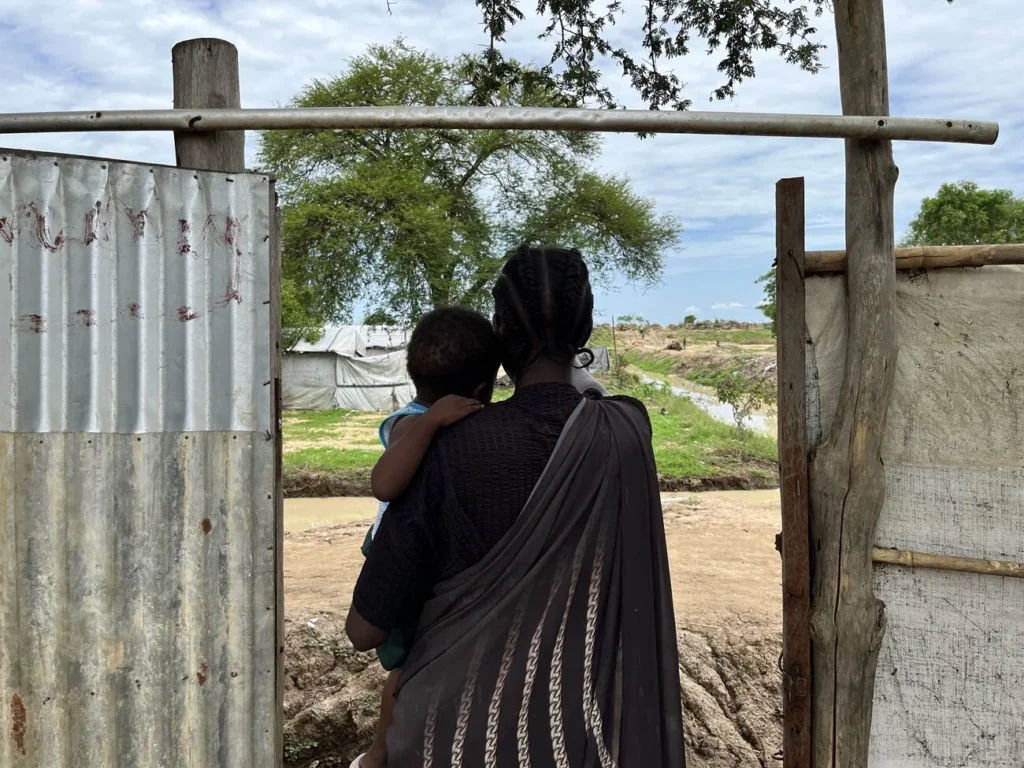

A survivor of conflict-related sexual violence and her child at the internally displaced persons (IDP) camp in Bor. South Sudan, May 2025. Federico Borre.

Children sidelined
For children affected by conflict-related sexual violence in South Sudan, the barriers to education often begin before even stepping through the school gates. Enrolment requires a father’s name on documentation – which most can’t provide as survivors cannot identify their perpetrators. In other cases, survivors, who are more likely than others to live in poverty, often rely on their children to work instead of going to school. Because survivors are regularly shunned from society and thus struggle financially, their children often arrive to school in worn-out uniforms without breakfast or money for lunch – making them ‘stand out’ from other students.
Those who can attend face walks of up to two hours along unsafe roads just to get to class – leaving their mothers to fear that their children will fall once again victim to senseless violence.
Survivors depicted these challenges through images of the violence they had endured, and what their children have been left to suffer. Some women drew bodies strewn across the ground with tanks in the background, while others depicted their children born of sexual violence standing at the edge of the playground, alone, cast aside by their peers.
Our children are discriminated against at home by our relatives and at school too, which affects them, and I feel bad to see my child going through that.
— Survivor, South Sudan
Survivors said teachers can in advertently be part of the problem too – questioning children about their fathers, or not paying attention to bullying and discrimination in school. Mothers shared stories of teachers pointing at children born of sexual violence and sending them to the back of the classroom. Educators in these areas are part of the communities themselves, and may not have been sensitised to the impact of sexual violence. Teachers need to be equipped and supported to deal with this.
Education is important for our children. One pen, one book is better in the hands of our children than a gun.
— Survivor, South Sudan
Bringing trauma-responsive teaching into schools
Education as a form of reparation goes beyond regular teaching and incorporates values-based, trauma-responsive learning into schools to help students with deep trauma. It also includes livelihood support for survivors, so mothers do not have to make the choice between providing for their families and giving their children an education. Classes are flexible to accommodate trauma, and can be adapted to children who have missed years of school due to captivity and conflict.
This is already being implemented in Nigeria, with our partner the Neem Foundation, where child survivors of Boko Haram captivity are returning to the classroom in schools dedicated to this approach. In South Sudan, GSF hopes to use a similar strategies adapted to the local context, drawing on the successes and experiences of Neem.
This was reinforced when we brought together actors from South Sudan’s Education Cluster, the national coordination body for education in emergencies. Fourteen organisations were represented in total, all delivering education projects across the country and each bringing different expertise. None had ever worked on education tailored to survivors of conflict-related sexual violence, but all recognised the scale of the problem in South Sudan. The gap in education is enormous – and survivors and their children are slipping through the cracks, they said. Some said they didn’t know how to identify children born of sexual violence or provide the services they need.
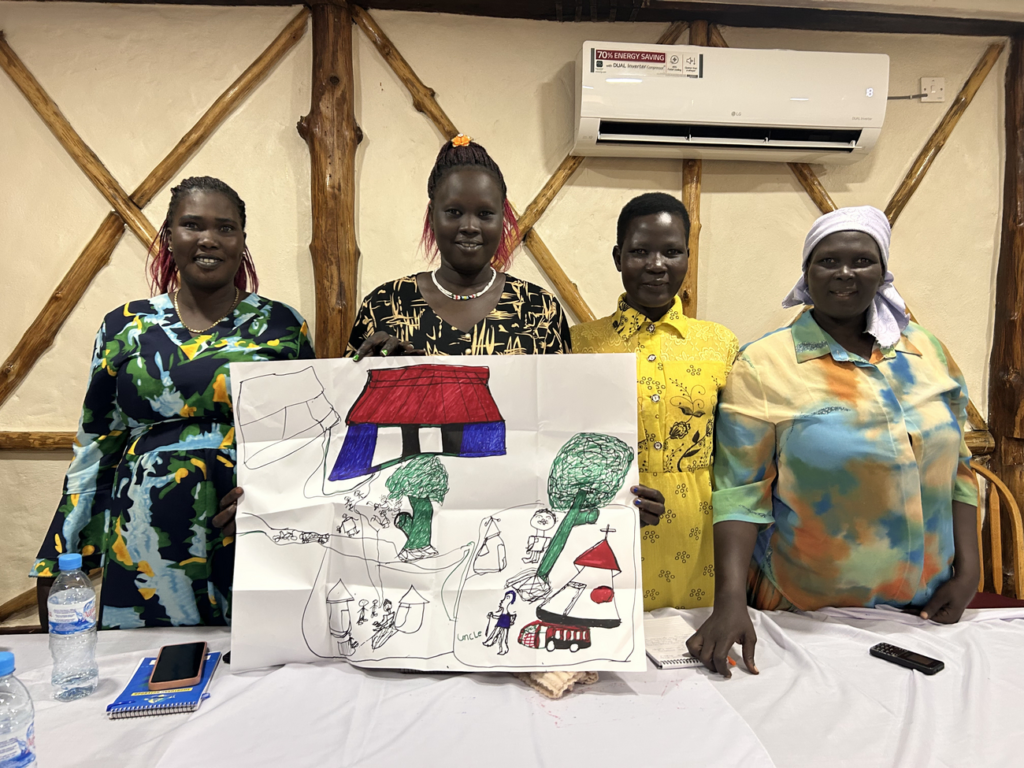
Survivors from protection of civilians (POC) sites and internally displaced persons (IDP) camps take part in a participatory drawing exercise during a workshop on education as reparation in Juba. South Sudan, November 2025. GSF.
Survivors also shared their vision for a new system. Teachers must be sensitised to the needs of these children, but communities must also be brought onboard. They asked for schools to provide counselling and psychosocial support to help them overcome trauma. While alternative learning systems are already in place, they are not tailored to survivor’s needs. This model can not only serve their children, but transform the lives of all children affected by conflict.
Whatever the classroom may look like, whether in a school or in a more informal setting, survivors had a clear vision: judgement-free, safe, and flexible schooling where their children can start to look to the future and learn, not hide in shame over their past.